
U.S. News | Posted Nov. 20, 2025 by SUSAN MONTOYA BRYAN
ALBUQUERQUE, N.M. (AP) — One of North America’s longest rivers, the Rio Grande — or Rio Bravo as it’s called in Mexico — has a history as deep as it is long. Indigenous people have tapped it for countless generations, and it was a key artery for Spanish conquistadors centuries ago.
Today, the Rio Grande-Bravo water basin is in crisis.
Research published Thursday says the situation arguably is worse than challenges facing the Colorado River, another vital lifeline for western U.S. states that have yet to chart a course for how best to manage that dwindling resource.
Without rapid and large-scale action on both sides of the border, the researchers warn that unsustainable use threatens water security for millions of people who rely on the binational basin…
The study done by World Wildlife Fund, Sustainable Waters and a team of university researchers provides a full accounting of the consumptive uses as well as evaporation and other losses within the Rio Grande-Bravo basin. It helps to paint the most complete — and most alarming — picture yet of why the river system is in trouble…
Read the full article on U.S. News here.
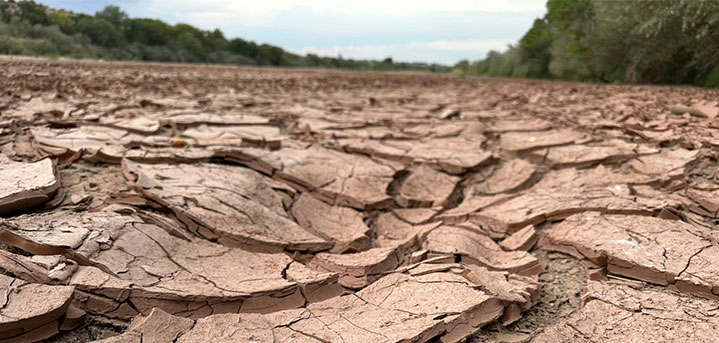
Photo credit: Cracked, dry mud makes up the riverbed in Albuquerque, NM on Thursday, August 21, 2025 (AP Photo./Susan Montoya Bryan, AP File)
Published Article Title: Overconsumption gravely threatens water security in the binational Rio Grande-Bravo basin
This is a partial list of other news article outlets:
- Boston Herald
- ABC News
- Orlando Sentinel
- Newsday
- The Press-Enterprise
- St. Paul Pioneer Press
- The Orange County Register
- The Philadelphia Inquirer
- San Diego Union-Tribune
- South Florida Sun Sentinel
- Los Angeles Daily News
- The Washington Times
- The Virginian-Pilot
- Chron.com
- San Antonio Express-News
- The Seattle Times
- Hartford Courant
- The Morning Call
- The Baltimore Sun
Abstract
The Rio Grande-Bravo basin shared by the United States and Mexico is experiencing a severe water crisis demanding urgent attention. In recent decades, water storage reservoirs, aquifers, and annual streamflow volumes have been substantially depleted, leaving little buffer for continued over-consumption of renewable water supplies. Despite the great scarcity of water and intensifying water shortages in this basin, a full accounting of the river’s consumptive uses and losses has never been undertaken. In this study we assemble detailed water consumption estimates from a broad array of sources to describe how surface and ground water were consumed for both direct uses (agricultural, municipal, commercial, thermoelectric power generation) and indirect uses (reservoir evaporation and riparian evapotranspiration) in each of 14 sub-basins during recent decades. We estimate that only half (48%) of water directly consumed for anthropogenic purposes is supported by renewable replenishment; the other half (52%) has been unsustainable, meaning that it is causing depletion of reservoirs, aquifers, and river flows. The over-consumption of renewable water supplies is primarily due to irrigated agriculture, which accounts for 87% of direct water consumption in the basin. At the same time, water shortages have contributed to the loss of 18% of farmland in the river’s headwaters in Colorado, 36% along the Rio Grande in New Mexico, and 49% in the Pecos River tributary in New Mexico and Texas. Farmland contraction in the US portion of the basin has resulted in lowered irrigation consumption and many cities have been able to reduce their water use as well, but irrigation in the Mexican portion of the basin has increased greatly, causing basin-wide consumption to remain high. This severe water crisis presents an opportunity for envisioning a more secure and sustainable water future for the basin, but a swift transition will be needed to avoid damaging consequences for farms, cities, and ecosystems.